Belize: wetland storks, jaguar forest and the reef
Not the former Mot Mot Travel tour company - we don't sell holidays.
Quick answer: Belize sits on the Caribbean coast of Central America, between Mexico and Guatemala. For birds, start with two protected areas run by the Belize Audubon Society: Crooked Tree Wildlife Sanctuary for wetland birds and the Cockscomb Basin Wildlife Sanctuary for rainforest. Come in the dry season, roughly November to May, when wading birds crowd the shrinking lagoons.
Crooked Tree Wildlife Sanctuary
Crooked Tree covers 16,400 acres, including more than 3,000 acres of lagoons, swamp and marsh, according to the Belize Tourism Board. The Belize Audubon Society manages it.
Its star is the jabiru, which the tourism board calls the largest flying bird in Central and South America, with a wingspan of up to 12 feet. Look for its huge bill and the red ring around its neck.
The best time is the dry season, roughly November to May, the tourism board says. As the lagoons shrink, Audubon reports that tens of thousands of birds gather in the wetlands, among them herons, egrets, storks and other waders. On a one- to three-hour boat or walking tour, the tourism board says you are likely to see 20 to 40 species.
Cockscomb Basin Wildlife Sanctuary
In the south, the Cockscomb Basin is forested hill country. The Belize government declared it a forest reserve with a ban on hunting jaguars in December 1984, and made it a wildlife sanctuary by law in 1986. It is often described as the world's first jaguar reserve.
Seeing a jaguar is rare, so come for the forest and its birds. Audubon says the sanctuary has more than 330 bird species and well-kept trails. Mel White, writing for Audubon magazine, notes that the Cockscomb area gets more rain than the north and gives February to May as its dry season.
Scarlet macaws at Red Bank
Audubon names Red Bank Village as a place to see scarlet macaws, which arrive every year between January and early April. The village is part of an Audubon and Belize Audubon Society project that has trained more than 50 local people as bird guides. Hiring a local guide is the best way to find the birds and supports the community that protects them.
Birds to look for
Belize's national bird is the keel-billed toucan, known locally as the "bill bird", according to the Government of Belize. Its rainbow-coloured bill makes it easy to spot in lowland forest.
Other highlights named by Audubon and the tourism board include the jabiru, wading birds such as herons and egrets, and the scarlet macaw. Belize also has motmots: listen for their low, hooting calls on forest trails. For field kit, apps and etiquette, see our Caribbean birdwatching guide.
Beyond birds: the barrier reef
Belize's coast is lined by the Belize Barrier Reef Reserve System, a UNESCO World Heritage Site since 1996. It takes in coral reefs, cayes (small islands) and atolls. For whales, turtles and other wildlife across the region, see our wildlife watching guide.
Best time to visit Belize
For birding, aim for the dry season. The Belize Tourism Board gives roughly November to May for Crooked Tree; Audubon puts the main wader season at about January to May. For scarlet macaws at Red Bank, go between January and early April.
The wetter months bring greener forest and fewer visitors. The Atlantic hurricane season runs from 1 June to 30 November, so check forecasts if you travel in late summer or autumn.
For UK travellers, February half-term and Easter fall in the dry season.
Getting there from the UK
Most UK travellers connect through a hub in the United States to reach Philip S. W. Goldson International Airport near Belize City. Check current routes before you plan. Belize is six hours behind GMT and does not change its clocks, so it is six hours behind the UK in winter and seven during British Summer Time.
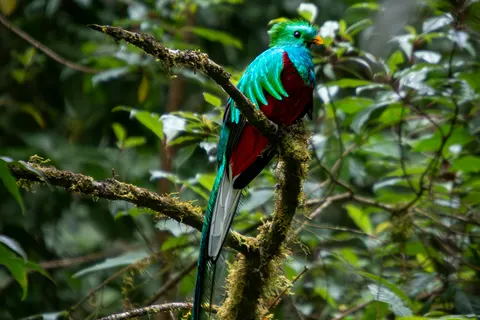
Planning a longer trip? Our Costa Rica guide covers quetzals, cloud forest and when to go.
Watch wildlife responsibly
- Keep your distance from nesting storks and roosting birds, and ask boat guides not to chase birds.
- Stay on marked trails in Cockscomb and other reserves.
- Never feed wildlife, and limit recorded bird calls.
- Hire local, licensed guides where you can.
Sources
All pages opened on 24 October 2026.
- Belize Tourism Board: Crooked Tree Wildlife Sanctuary
- National Audubon Society: Birding and ecotourism in Belize; Mel White, Beautiful and Bird-Filled Belize (Audubon magazine, 2013)
- Government of Belize Press Office: National Bird - Keel-billed Toucan
- UNESCO World Heritage Centre: Belize Barrier Reef Reserve System
- NOAA National Hurricane Center: Tropical cyclone climatology
- GOV.UK: Belize travel advice (still current 24 October 2026)
Frequently asked questions
Where is the best birding in Belize?
Start with Crooked Tree Wildlife Sanctuary for wetland birds such as the jabiru, then the Cockscomb Basin Wildlife Sanctuary for rainforest birds. Both are run by the Belize Audubon Society.
What is the best time to visit Belize for birds?
The dry season, roughly November to May, when wading birds gather at Crooked Tree's lagoons. Scarlet macaws visit Red Bank between January and early April.
Do I need a visa for Belize from the UK?
We don't state entry rules ourselves, because they can change. Check the GOV.UK FCDO entry requirements page for Belize before you book; the same advice covers safety and security.
What is the national bird of Belize?
The keel-billed toucan, known locally as the "bill bird".